


I started this post as a list of topics to cover in some lectures I’m giving on arranging—and I got a bit carried away. Over the past few years, I’ve been doing more and more: from contributing one or two charts as part of a team to putting together entire shows.
Artists I’ve worked with in the last 18 months include TechN9ne, Killer Mike, Tobe Nwigwe, Kem, Busta Rhymes, Ledisi, Sia, Dua Lipa, Sophie Hunger, Guster, Parkway Drive, Big Sean, Joe Bonamassa, Ibrahim Maalouf, the Metropole Orkest, and the BBC, Detroit, Kansas City, and National Symphony Orchestras.
These days, there’s a lot more to working as an arranger than just knowing how to voice a chord. With this post, I hope to pass on a lot of tips, tricks and treats from my experience.
Pre-production
First thing after getting the call
ChatGPT the artist. Ask for a bio, list of best-known tracks, tracks that show off their style, set lists, links to the YouTube videos of live versions and album versions on your streamer of choice.
See if they have done anything with orchestra before. Look out for any Tiny Desk concerts or acoustic shows. This helps to see if they can play in a stripped-down way with no tracks or big production.
Questions for Orchestra/Employer
- What is the orchestra? Size, Type (regular or pickup)
- What are the doubles available?
- Is this a one-off or will it be used again?
- How many rehearsals?
- One or Two sets? (if you are putting together a whole show)
- How extensive will the amplification be?
- Who is copying?
- Budget?
Questions for Artist/MD
- Is the band from the artist or orchestra?
- Backing Vocals?
- Tracks? If so, ask for them.
- Request live versions that match the form they currently use.
- Does the artist talk a lot in shows? (Helps to know how many charts you need)
- How open to being creative are they? Intros? Codas? Interludes? None or reduced band sections? Re-harms?
- Do they have any lead sheets or existing charts?
- Who reads and who does not? You never want to put anyone on the spot, so important to know.
Takedown
Tools- Digital Performer, Transcribe, Moises
First, load everything you have into DP. If you don’t get stems, split the mix into your own stems using Moises or something similar.
Put it on a grid, it will save time later.
You can search for any existing sheet music or midi files, but be careful; most of it has mistakes or might not match what the artist now does, so this is often pointless. For most of the work I do, there is none anyway. I have done several gigs where I was given existing arrangements to build from, and every time there have been so many mistakes that it would have been faster to start from scratch.
Take it all down, everything, you never know when you will need it. If the rhythm section is from the ‘orchestra’, you will need much more detailed parts. This is quite often the case with the Metropole Orkest. If the artist has a band that knows their parts, you will still want all of the bass, chords and any important lines you might need to double or avoid. Grab all of the bass and some other parts, even if you don’t need them (this helps your writing process). As you work, you will want to play back your score to check things out, so you need to have some bass and rhythm parts to know if it is all going to work. Another thing to be sure to do is to paste out the bass through the whole chart, even if it is covered by slashes, so you can hear it all the time when working. Just remember to mute any of the parts for the demo if you are playing it back over the original artist files.
If it is a Hip Hop track, it is often much easier to take things down from the original samples, or at least reference them. www.whosampled.com is a great place to look. I used this a lot on the J Dilla Detroit.
If you can’t hear the bass properly, even if after splitting it out, try putting it up the octave.
Process
I play the track and start singing or jamming along, coming up with ideas. I never create any grand outlines or plans before I start; I let it evolve organically as I work from left to right. I let the song inspire me. A little dirty secret: I’ve done many charts where I haven’t even listened to the full song before I start writing. While I used to do all my own takedowns, these days I don’t, so sometimes the first time I hear the full track is when I already have the sketch open in my template — and I can’t help myself, I start putting ideas in right away at verse one.
I find this part of the process the most exciting, so I tend to fill it up, overdo it. For strings, I flesh out the full section as I go, but for woods and brass, I sketch on fewer staves. I get to the end, step back, and look at what I have. Sometimes, what I have in the first verse might get thrown out — maybe it is not needed. For verses, I tend to do different things each time; conversely, choruses are often similar to each other. To achieve a nice shape, you don’t want each chorus to be exactly the same — you want the first to be a little less, with each subsequent chorus getting bigger. I often fill that first chorus up, then paste it to the rest as I work through, then go back and strip things out of the first. The second is often what I originally had for the first, and so on, until I get to the last, where I add or change things enough to take it to 11.
You do not need the orchestra to play the whole time. It is totally OK to have a verse or two with them all resting. Don’t feel you need to justify your existence by filling every bar with unnecessary notes.
A lot of the artists I work with still use tracks. I have them mute anything orchestral— legit orchestras don’t take kindly to “playing along,” it’s a bit disrespectful. I might leave other elements in the track, double with the orchestra, or completely redo. Sometimes we leave bass and drums in the track. There are no hard rules, but everything should be considered carefully as you work through the arrangement.
For Big Sean, we decided to keep the bass and drums on track. I just conducted Nas: Illmatic—the show that pretty much changed my career 11 years ago—and it is entirely live, everything is played by the band, orchestra or the occasional sample trigger by the DJ.
Easy Creative tricks
While it would be great to just be given the name of the song and the key and be told to go for it, that is pretty rare these days. Most gigs I do involve adding an orchestra to an existing arrangement. The form and harmony are already set and not easily going to change. If this is the case, what are some things to do that show off your work and the orchestra, but don’t make life hard for the artist?
- Add an Introduction. I will do this after finishing the chart as you can often use material you already have written for it. Even if I don’t use any existing material, doing it last means I know the song much better and will be more ‘inside’ it so my ideas will be more related. Writing an intro gives you a chance to feature the orchestra and not make the artist worry too much about learning a new version. Just make sure it flows easily and obviously into the normal start of the song.
- Add a Coda. This comes with similar wins as the Introduction, but runs the risk of being drowned out by the crowd who will still usually clap at the end of the song as they know it!
- Add an Interlude. This can very rewarding for all, but means the artist and band have to learn a new arrangement. It might scare them, or there just might not be enough time for them to rehearse it and feel comfortable.
I am not suggesting you do all three on every chart. Sometimes you don’t need to do anything extra; there might already be space in the song that will give the orchestra some time. I also often put together whole shows and you don’t need everything to be a huge orchestra showoff piece; I can plan it out over the show.
I find there is a good balance to be had with most artists. If a show has 15 charts, make 10 of them easy, without any changes or things to remember, so they can sing the song as usual and the orchestra is there to enhance. For the rest, add some intros and then, with the artist’s consent, pick one or two that you can open up a bit and be creative. Think of the show as a whole, don’t think every chart has to be your magnum opus.
Broad strokes win in most live situations where there is a full band and PA. Small details are just lost.
Easy rookie pitfalls
- Be sure not to make this about you, it is about them. It is not a chance to try out some crazy texture that needs an explanation more than 3 words on the part, do that with your own orchestra!
- Understand the band is going to be loud in most cases. Think about what you write, will it be heard?
- Always think twice before having the orchestra low end double the band low end. Of course, in a big tutti, go for it, but they do not need to do it in the verse just for the sake of it. And make sure you have the right notes!
- Thinking that everyone has to play, and play a lot. This is not high school, players are quite happy to play one passage or none. They will enjoy that more than mindlessly doubling stuff that is not going to be heard, or sound like a concert band if it is. As already mentioned, you can leave the orchestra out of whole sections of a song, they do not need to play the whole time. Space will give you more impact when you do have them play.
- Unless you know the orchestra and band, think twice before having the orchestral percussion section play groove/rhythm parts. Do not write things just for the sake of giving them something to do.
- Not understanding that this might get just one run-through before the show and that is for the artist. There is no time to experiment or change things on a pops gig. Best case you get a rehearsal, then a sound check/show run with no stopping. I have done many shows where there is just one one run-through on the day of the show, which means everything must play down perfectly with no or minimal questions. Recently, with Detroit and Big Sean, the only rehearsal was the afternoon of the show and I also had a 10-minute, never-before-played overture to get through. You must know what works and sounds impressive but is not hard for a professional orchestra. They are NOT going to look at it ahead of time. Principals might give it a glance, but that is it.
- Not having the melody, lyrics (at least the first line of each section) or band guides in the score for the conductor to see.
- Have the orchestra sing, hum or clap. Hard no for professional orchestras.
Post-production
Keep a list of places that the artist needs to pay attention to. If there are tracks, work with the MD on muting any orchestral elements or things the orchestra is going to play. On several recent gigs, I have gone as far as recording slates for myself, or the conductor, if it is not me.
Score
- Be sure to have lyrics in the score. I often just have the first line of each section in a font that can easily be read by the conductor. The whole melody will be there of course, or slashes if it is a rap.
- Make sure the layout is logical and easy to follow. Fit the pages to phrases. You can often fit 8 bars on a page. If you have to have four bars on the next page, move the right margin over to compensate. Don’t have a really widely spaced page after tight ones, it looks amateur.
- Rehearsal letters are a must. Some people label Verse and Chorus, I don’t bother with this unless I am helping out on a team that is all doing it, then I play nice. But if the gig is all me and my team, we never bother and have never had an issue.
- Make sure you have guides for what the band will play or for anything on a track.
- Use proper stave numbers. Double winds can use 8 staves, triple winds also use 8 staves unless the music is too complicated and will be messier if condensed. Horns use 2 staves (if I see 4 horn staves in a score, I assume you either don’t know what you are doing, you are lazy, or some combination of both and you will be judged!). This will give you a nice visual balance in your score with things in predictable places. As a conductor looking at brass where every part has it’s own stave is irritating as it leads to more space the eye has to look at and osten means what is there is smaller to fit all of the staves.
- Trumpets: put 1st on its own stave, and 2nd and 3rd on another. I know this goes against the tradition, but it makes life much easier. Who plays any solos? Who rests, getting ready for the big bit while the others play? Grouping 2 and 3 just makes way more sense. Trombones: 1st and 2nd on one stave and Bass on another.
- Put the Vocals and Rhythm section above the strings, below Harp and Piano.
- To transpose or not to transpose, that is the question. Check with the conductor, it depends what world they are coming from. The default in this world is transposed, but people like Jules Buckley and myself prefer concert scores. I have spent my whole career looking at concert scores seeing the part transposed in my head. For others their brain works best the other way. That said, anyone working as a professional can read and work with both.
- Use key signatures.
- DO NOT hide any staves/optimize. Leave the whole orchestra showing, it makes it much easier for the conductor to follow.
- Large time signatures always help a sight reading conductor, but not too big that they become a focus. Check out this page on how big is just right!
- Large numbers on every measure at the bottom of the score.
- Text and tempo information goes above the top stave and Violin 1.
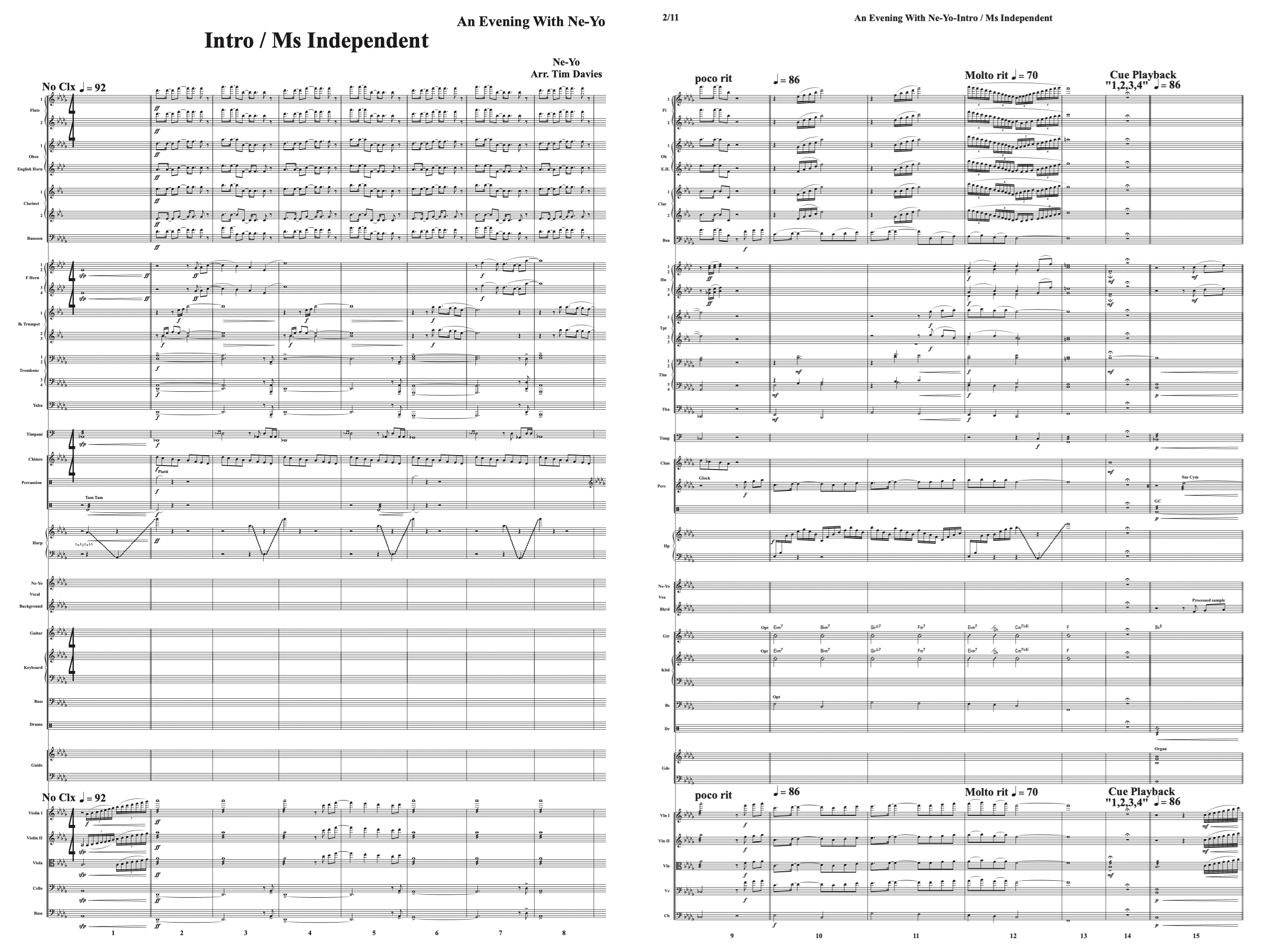
Demo
- Demos are a must on 99.9% of gigs these days.
- Using the stems you have, lay the orchestra demo over the artist and make a mix that works well to give the artist an idea. DO NOT mix the orchestra too loud, this will lead to more questions and gives a really false impression of what it will sound like. Of course, you want them to hear what is going on, so it will be a little louder than the live balance, but don’t have it dominate.
- Depending on budget and profile of the project, this could be NotePerformer, a hybrid, or a fully programmed demo. If you have a good relationship with them you might get away with something very basic. If it is your first gig with a new client and you find you have to apologize for the demo, then you need to make a better one if you want them to love you!
- Sometimes you need to flatten the tempo of the demo if it is from a live recording. This will make it easier to put a NotePerformer demo back over the top of it without too much editing.
- I like to make a score video for the artist. They always enjoy seeing the score and it gives them a reference if they want to give you any notes, even if they don’t read music. I used to use dropbox capture for this but it was recently discontinued and after a lot of searching I have settled on a program call Zight.
Here are some examples of demo videos.
Woodwinds
- Avoid mindless/pointless doubling. It leads to a very traditional sound, which is fine at times but there are so many other creative things you can do to make it your own.
- Try the arpeggiator approach or dovetailing with delays and overlaps.
- Know if and when they need to breathe and write accordingly.
- Be careful with doubles, even standard ones. The more famous the orchestra, the less chance you have of anyone doubling, always confirm beforehand what you can do.
- Most concerts you will get double woods. It is rare to have triple woods on a pops show, and you don’t have to use them all either way!
- Bassoons are not bass guitars or trombones and I often leave them out on loud hip hop gigs.
Here are some examples of my favourite woodwind techniques. I like to create interesting textures. Also notice that all the breathing will now be spread out and predictable and will be unnoticeable.
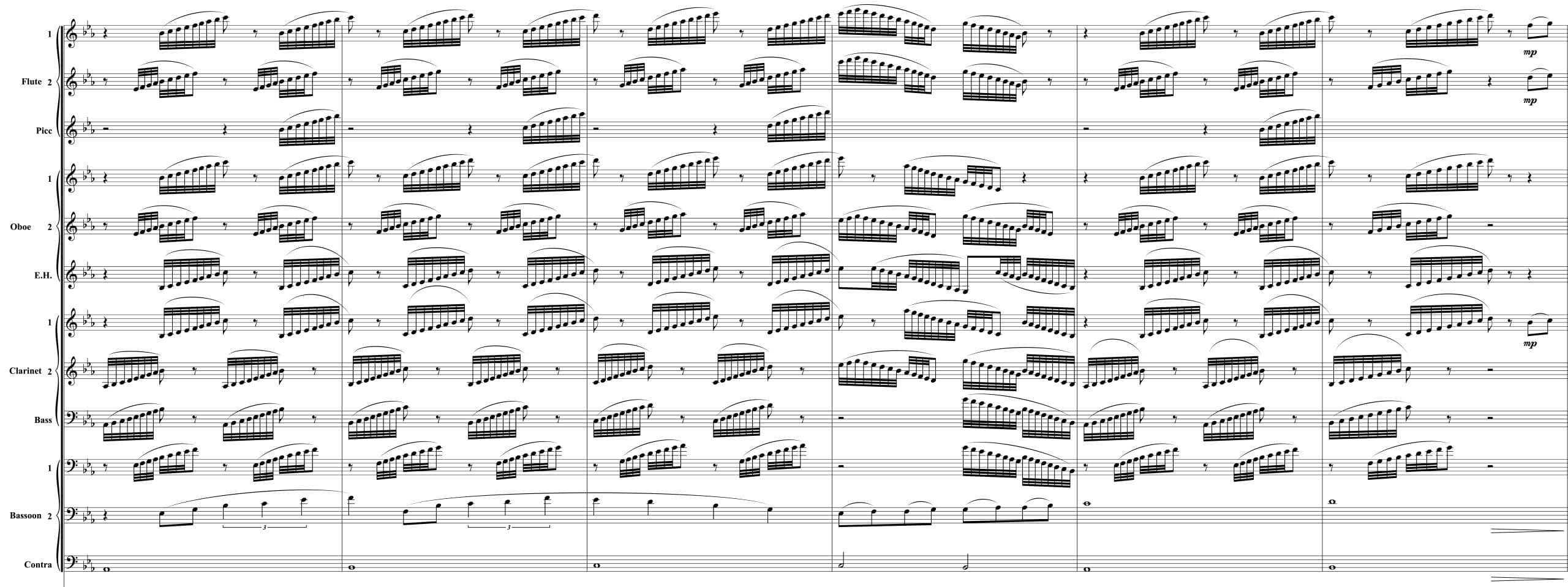
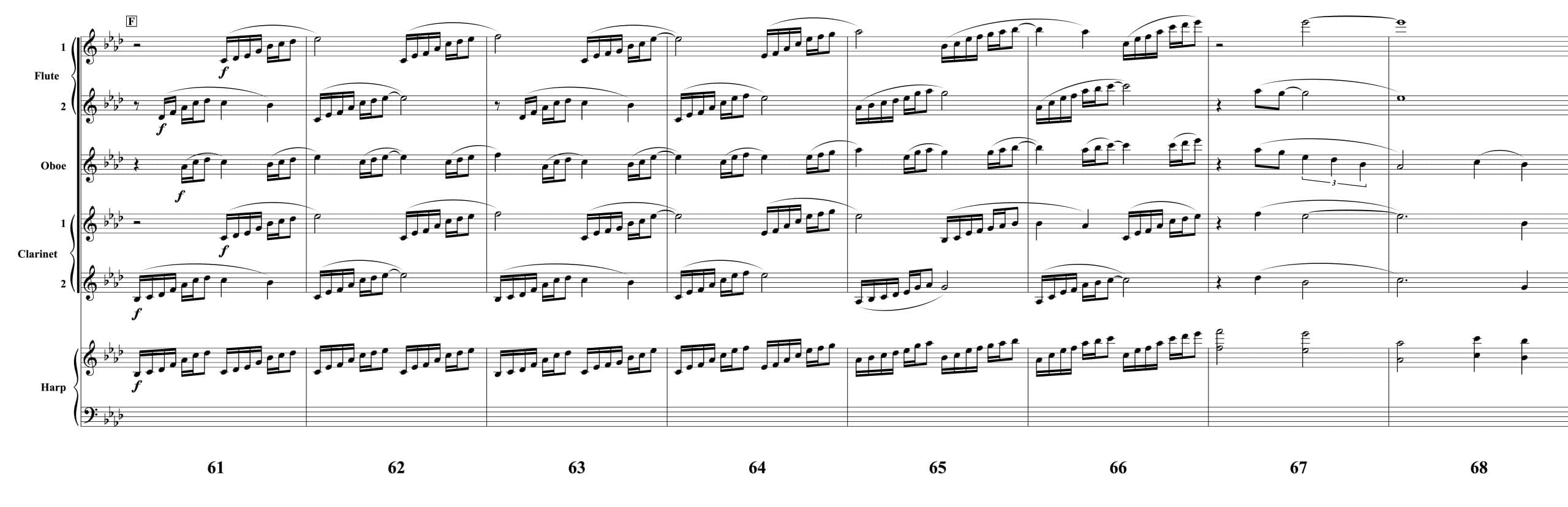
Brass
Horns
- Unison is awesome.
- Avoid low if you want clarity and focus.
- Use them for Epic counter lines in the upper register so they cut through and lift the orchestra. Awesome for the last chorus.
- If you have four horns and only need three notes, double the top one, this gives it a smoother tone and makes the section sound bigger.
- Use key signatures. It is an age old question and debate, but I am right, as usual.
- Interlock them as that is what a legit section is expecting.
Trumpets
- Will overpower if you are not careful.
- Keep range in check unless you need it to sound like James Bond. If not, don’t go too high (past C). You risk them missing or picking up a piccolo and no good can come from that.
- Be careful with Harmon mutes, they can be very hard to blend and lines are often uneven.
- Check if they are using the orchestra’s 1st player or bringing in a lead player.
- In the US, Australia, and Europe, most orchestras will use C trumpets. If you have a scratch band with show players or a lead player brought in, they will play Bb. In London it is all Bb. I hate C trumpets, and, unfortunately, it does not matter what part you make, C or Bb, they will play C most likely and annoy me to no end.
Trombones
- Great for filling out the ‘pad’.
- In a legit orchestra it will be two tenors and a bass.
- The tenors will have triggers, but make sure you know what you are doing if you go low, past E.
Tuba
- Be careful in a hall, don’t go too high, it does not blend well.
- It is not a trombone.
When writing big tutti’s, think about the impact of entries and how people will breathe. You don’t need to tell them when to breathe, that is usually obvious, but knowing when they will do it will help your writing.
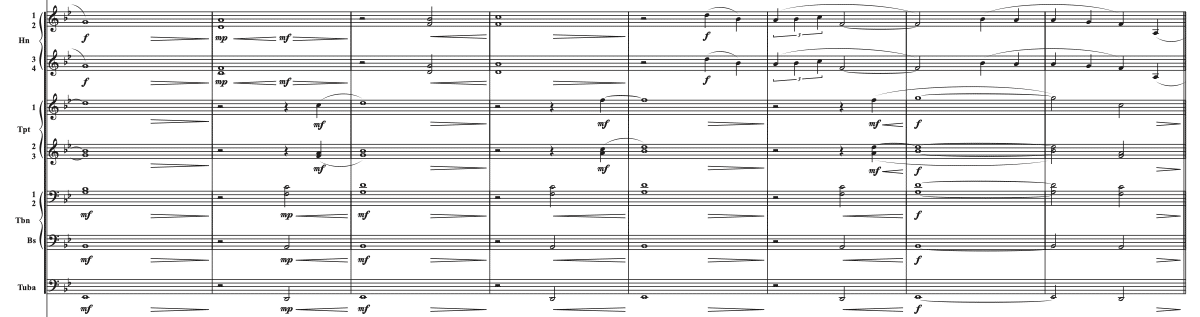
Percussion
- Timpani is very effective, great for adding drama or filling into a new section. Don’t overdo it, it will diminish it’s impact. Think of it as a turbo boost. Don’t underestimate their pedaling skill, but don’t tell them when to do it. Write the notes you want, they will work it out.
- Bass Drum and Suspended Cymbal are good for bridging sections. Don’t go overboard or they lose their effectiveness.
- Chimes and Glock work well and cut through.
- Vibes are very versatile. They can play tunes, chords or riffs.
- Xylophone, be careful, pretty loud and dated sound. I avoid.
- Marimba, often not heard and if it is, sounds awful. I avoid unless I am forced to use it. There is something weird about the sound of it at the back of an orchestra in a concert hall that has always bugged me.
- Be careful with adding shakers, congas, tambourines, etc. Does the music really need it? Can these players and the hall make it work?
- Do not think you are going to be cool and have the orchestral percussion play as a split up drum kit, hard no. It never works. If you need a kit, have a kit.
- I always use a five-line staff, it makes it easy to notate multiple instruments at the same time and also cut down on labels.
- Legit orchestras in general prefer one part per player, not a percussion score. That said, if I have three players and one is on mallets the whole time, I will give them their own part and the other two I will put together.
Harp
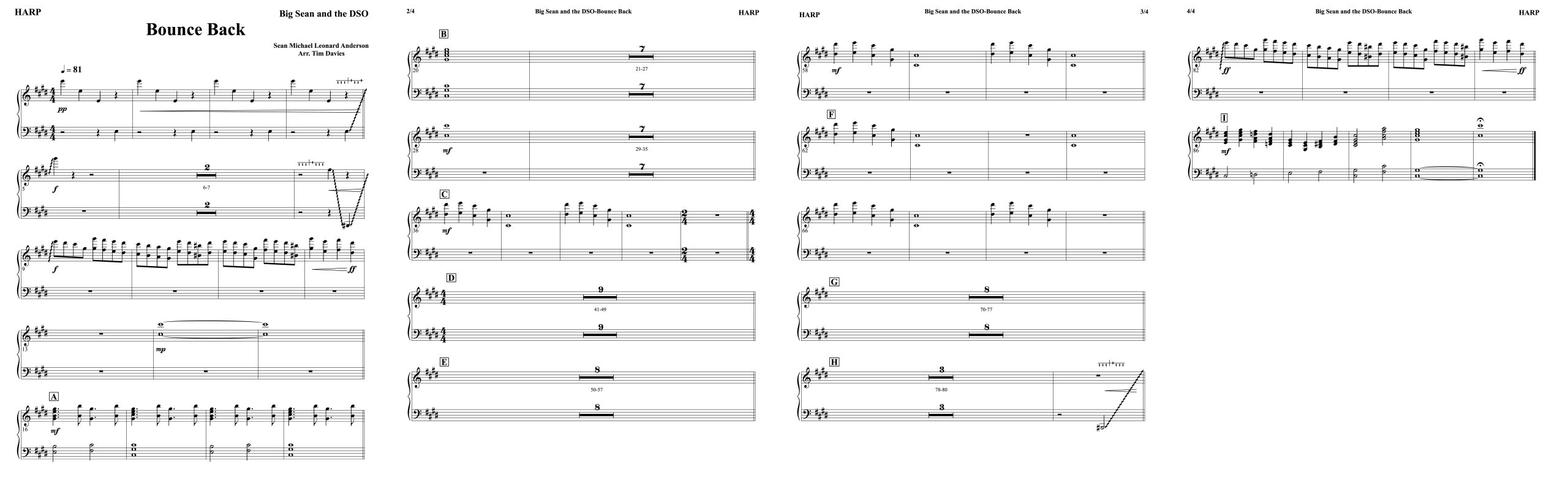
- Always consider if the part will be heard, and if it is, will it sound any good?
- All notes in a phrase will ring unless you tell them otherwise, that is the default.
- Write full durations where it makes sense, as opposed to short notes and ringovers. It makes more musical sesne.
- Glisses are effective and cut through.
- If it is loud or a large crescendo, they will add to it using both hands and a few swipes. If in doubt, I just say ‘swirls’. There is no need to get carried away with lines all over the place, do you really think they don’t know how to play a big gliss?
- Don’t make glisses too short, they need some distance to be effective. Some harpists will sense your incompetence and add an octave or two, but some will play your one-octave gliss and it won’t be heard or have any impact.
- For glissandos I use a pedal diagram. Apart from that, nothing else is needed. They will work out and write in their own pedals. You will either fuck it up, or put them in the wrong place, so just leave it to them!
- It is not a piano.
Piano/Keyboards
- Piano is often not needed if there is a full band.
- Celeste can be effective in places. I prefer them to use a keyboard /sample for it as it will be easier to make it louder. A real celeste is not loud.
- Every orchestra these days has a keyboard with piano, celeste and organ sounds or a controller and MainStage.
- I like to use synth bass at times. If you have a section where the band drops out, you need to fill the low end, the orchestra basses just won’t cut it. Adding some synth bass really helps. It is a bit like having the organ pedals but easier to do and will be in time.
Strings
- Avoid too much divisi, it will thin out your sound. You may get 22 violins on the first show, but 11 years later you hear it with 13. This just happened with Nas and Illmatic.
- If there are only 2 parts going in the strings, have all the violins on one and viola and cello on the other. The more the better on everything.
- If you have a small violin section, have them all up on the high line.
- Avoid pizz unless there is nothing else going on around it or you have lots playing it. Even then, be careful; it can’t compete with a band in most situations.
- Same for Col Legno. They are not going to smash their instruments so it has no chance of being heard in 99.765% of cases.
- Avoid too much bass doubling for the sake of it, and don’t think it will be cool to have them play along pizz, it is not….
- When writing motor rhythms, be careful with rests, accents or tricky syncopations as they can kill the groove. Continuous, even bowing is the easiest and often has the most impact, the accents can come from other instruments.
- Avoid artificial harmonics. It might look like a flex in the score, but it won’t sound like one; more like a train going around a tight curve, but worse.
- Basses are not cellos.
- Mutes are a great sound, but will it be heard?
- Do not write the bowings in your score.
For All
- Keep the notation language simple. They will be sight reading.
- I never use descriptive text for anything. Just get the dynamic and articulation right and you are good to go. I don’t even put a description at the top, just the tempo.
- All orchestras can play swing from regular quaver notation. You just say ‘Swing.’ They can do it. Will it sound good? Maybe not, but it will be no better or worse than had you written it all out in triplets.
For more info on how I write for strings, check out my Error Code 7 post.
Rhythm Section
This needs its own whole article! I am often surprised by the lack of knowledge that even experienced arrangers and orchestrators have when it comes to writing and notating for the rhythm section. I don’t even know where to start, I am just going to say get your shit together people and leave it at that for now.
Parts
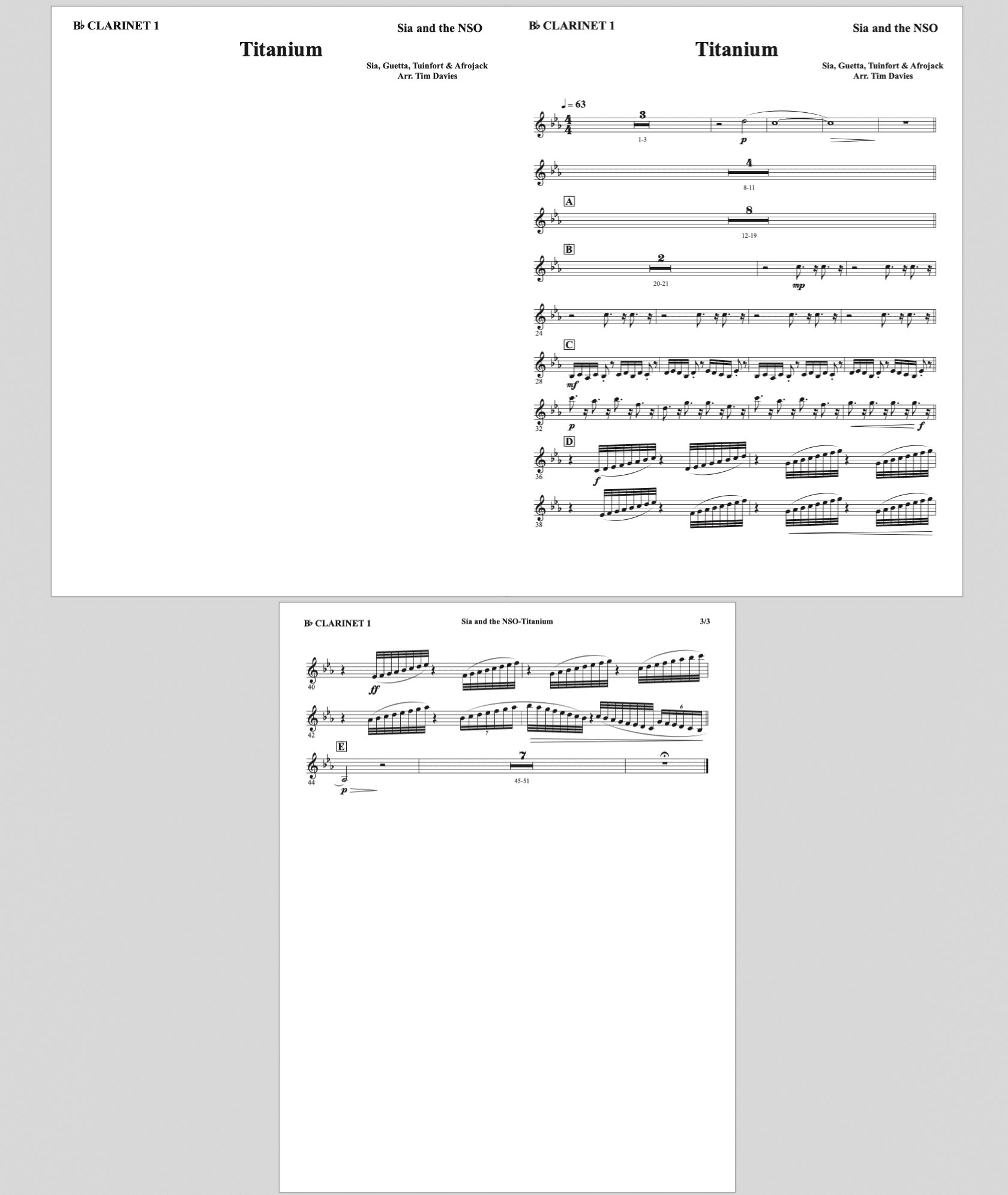
- If you look at legit parts, things are jammed up and pretty small. Studio parts are spread out and big. Pops parts should be somewhere in the middle. The orchestra is going to be sight reading, so you don’t want to make it too small.
- Make sure the layout/measure per system is helping with the form and not hindering it.
- In the studio you need measure numbers on every measure but don’t need rehearsal letters. In pops parts you don’t need numbers on every bar (unless it is for a workshop, or you are going to make a lot of changes) but you need rehearsal letters and do your best to have them at the start of a line. Also include the measure number range on the multi-measure rests.
- Don’t make multi-measure rests too long, break them in places that help feel the form.
- You need page turns. You don’t have 12 first violins to have 6 of them stop on that big run up into the chorus because you did not consider page turns. They need to turn on 1/3/5 etc. While in the studio you can shuffle pages along and have 4 or 5 open, you can’t do that live. Parts are always booked. If it is a 2-page part, you need to make a blank title page. Don’t question it, just do it, or you will have unhappy librarians doing it and we like happy librarians. Commercial copying is traditionally 8 lines on page one and 10 after that. With A4 you can often have 9 and 11. Any more than that and it is too small. It is OK to have an incomplete page if it makes the page turns work. If you do this, DO NOT let the notation program spread the remaining systems out to fill the page. There is not a world known or unknown to man where that helps, or looks good.
Rights
You have none as an arranger! Just accept it. If you want control over your work, or royalties, change to being a composer. Depending on the use, you will either be working for the artist or label that owns the publishing, or the orchestra that hires you is responsible for securing any permission. Your creative work, the files and the paper it is printed on are all owned by the publisher, not you, not the orchestra, unless someone did a deal to secure further permissions, which has never happened in my career! Until recently, you could not sell any arrangement legally unless you got a deal directly from the publisher, which was tricky, if not impossible, in many cases. Now there are services like arrangeme.com where you can get permission to sell the arrangement. The catch is that they and the publisher take most of the money. There are also steps in place to make sure you do not use it as a workaround to do a one-off deal, so don’t get any ideas. Let’s say the MSO asks you to arrange a song for a tribute show to John Farnham. The work is done, the show is over and you want to sell your chart, or someone asks for it. You could put it on arrangeme.com. How does this look to the orchestra? Even though they do not own it, they tend to feel a sense of ownership as they paid you to create it. Is it worth the potential bad blood from the orchestra to make some pocket money? If you really want to sell it, I would ask the person that hired you if they mind. Of course, people make up with all sorts of dodgy arguments for breaking copyright law: it is an orchestral school concert, it is for a school, it is educational, no one is making money etc. None of them hold up legally. This all came to a head in the States a few years back when a company called Tresona started to threaten schools, orchestras and artists with lawsuits if they did not acquire the permissions. Of course they were there to help! The catch and the ultimate undoing was that they were a middleman, not a publisher, and, when a big case finally made it to court, they were found to have no standing and the suits were thrown out. The actual publishers were not that happy with them as well as it made them look bad. Tresona has since gone back to their core business of being a middleman, a place you can go to to get permission for one-off arrangements. This is a much bigger industry in the States with all the marching bands doing custom shows every year etc.